
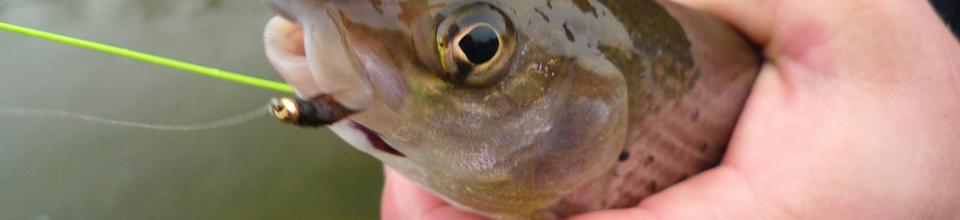
Look at this fish —
just look at it.
These scales, they might as well be tombstones. What kind of creature buries itself alive? A dead one, that’s your answer.
Without people like me to look at fish like these, you’d never get to the underside of anything.
It’s true, we’re not the glamorous type. We’re the lonely ones, the ones who take long walks on the beach without the slightest hint of irony. We don’t do it to find ourselves, but other things. Dead things. Moss and rot and snakeskins. Fish that choked to death swallowing other fish. It all washes up, sooner or later.
You might be afraid of our mustaches, or the way we tuck our T-shirts in just so. Say what you want about our milky breath in your ear: If we didn’t hover over you like pigeons on the wire, you’d never know how much a dead fish looked like your grandmother’s bare thigh.
I must confess I’m thinking of my own grandmother, bless her fishy legs. She was with me when I first saw one—right away, I picked the thing up by the tail and held it up next to her: like mountains on lake water.
I was like that, my grandmother said, always prodding around. She and my grandfather had a place in northern Michigan, an old house with filthy panel siding tucked in the woods across the street from a cemetery. I grew up there, in a village that’s been rotting for as long as I’ve been poking at it.
My grandmother would bring me along on walks through the woods before her mind started to go. She always stuck to the foot-worn trail, letting me wander farther and farther before finally calling out or finding me peering into some decomposed tree trunk. She knew me as well as I knew those woods, every slug under every muddy stone.
Sometimes I’d stay near and she would point out deer beds, the slick droppings still steaming in their imprints under white pines. The musky, grassy smell of fox turds.
There are at least ten types of shit in any stretch of woods, she’d say. By the time you’re grown, you’ll know what each one of them feels like between your toes.
She was right, too.
I was barefoot the day I saw her wade into the crik. The day she emptied her row of prescription bottles in the trash when my grandfather wasn’t watching.
It wasn’t one of her bad days, the days when she’d stop mid-stride on her way to the front room and stand wide-eyed in the doorframe, mouthing questions to the walls. The days she would sit me down on the couch, clutch my hand and tell me long stories of her time as a nurse in the war—how a single syrette of morphine could make a dying man drool—and then stare at me in shock like I had just arrived.
On the day I saw her in the water, the day I backtracked the blood trail to the crik, she asked me to help her pick a bouquet of flowers—pale touch-me-nots, she said—for when my grandfather came home from work.
I stopped at the shed to grab my rod and tackle, a slightly bent putter from my grandfather’s golf bag with a chunk of sourdough hooked on for bait. The crik cut through the woods and flowed all the way to town and back into Lake Michigan; I liked to sit on the steep bank and cast for brook trout, fighting through snags on the mucky bottom.
It didn’t take long for my grandmother and I to separate—her with her back turned, picking flowers; me discovering the splatter of drying blood in the flattened leaves, scratching at it with the putter, tracing it off the path.
I followed the trail down a ridge, tracing half-circles when the spotting grew faint at the base of a small black spruce. A few drying pools marked where the deer had curled up and later been dragged away. I knelt down and swept my finger across the trail, adding up the pints of blood it must emptied on the forest floor.
On my way back up the ridge, I realized for the first time that my grandmother hadn’t come looking for me.
I started walking east up the ledge above the water, backtracking to where we had split ways. I made my way down the ledge and walked along the bank of the crik, busting up the clumps of flies buzzing around small carcasses and watching the mud bubble up through my toes. By the time I look up to find her, she was less than twenty feet away.
I saw her left tit before anything else. She was standing with her shirt off on the opposite bank, stooped down and stepping toward the water.
I was behind that tree faster than the water could sweep her saggy bra away, peering around the black ash sapling as she stripped down to her underwear, sliding the yellow cotton down her piscine thighs.
I watched how she waded in naked, a prune from the neck down, sliding into murky water.
How she dropped to her knees in it, floated on her back, closed her eyes.
How easily she lay with her topside to the sky, placid.
From behind my tree, I fought the urge to reel her in.