
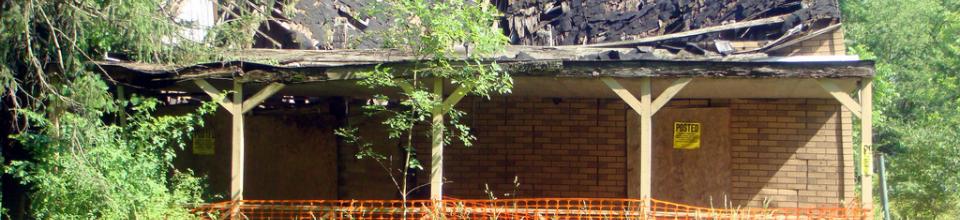
More houses fell to disrepair each night. When I woke up in the morning, I pressed a kiss onto Emily’s forehead and went to the window, spreading the curtain wide so I could look both ways down the street. Another house, empty. But not just empty and abandoned by its owners: the empty house’s shingles would be sliding off the newly-sagging roof, the grass growing as tall as the mailboxes that were covered with orange rust. The driveway, crisp and straight just the day before, would be cracked and chipped. The front door would hang loose like a pair of ill-fitting pants, the windows smeared with grime.
The remaining neighbors acted as though nothing was happening. We would nod toward one another as we left for work, staring straight out our windshields as we drove, keeping our gazes from crawling over the destitution that had fallen on the houses around us. Some yards were a burnt sienna color, as though someone had torched the grass. Broken windows pocked houses like broken teeth. We didn’t have dinners together anymore, families huddling together alone as night fell, clutching their utensils, staring at the green buzz of microwave and oven clocks, everyone silently wondering if they would go next.
We woke up sandwiched between two decimated lots, the unkempt grass wriggling up against the wooden fence on either side. Marilee and Mason had fearful tears in their eyes at the breakfast table, but they did not ask questions when we shuttled them off to the school bus and Emily held my hand, plastering a smile on her face and waving to them as the bus drove off. We both silently wished that it would never bring them back, take them away to somewhere not drenched in anxiety and uncertainty.
“When will it be us?” she asked as we walked back to the house.
I bent down and picked up the morning newspaper wrapped in yellow plastic.
“I don’t know.”
One morning it was finally Rod’s house, the tudor across the street. I woke to chipped bricks crumbling in piles in the front yard. The oak tree was dead, its branches slumped and defeated. His mulberry bushes, the ones he’d taken such pride in, were wizened and blank. The car he washed every Saturday morning was gone, the house’s white window frames chipped and unlevel. With Rod gone, we were the last ones left.
Nausea blanketed our house. The children wondered what had happened to their friends. I had to tell them that I didn’t know. Rod had two kids, too, and the four would chase one another through our yard and his, play ball in the road, invent games as they raced their bikes down the streets. I hugged my kids close to me, could feel their tears stain my shirt.
We sat together on the couch that night after we ate, the four of us cramped together on the loveseat, Mason on my lap, Marilee perched on Emily’s knees. We turned on the television, volume low, watched the news over and over, looking for some signs. But nothing came, just the regular weather reports and stories about job loss and political unrest. As the sky grew darker and the clock over the television ticked in vicious circles as the hours passed, my gaze met Emily’s more frequently. She chewed her lip raw. I could see her knuckles going white from holding Marilee so close. I wanted to shrug, I wanted to reach out and hold her hand, tell her things were fine. That we’d be fine. But as night marched on, crossing over to midnight, as the children grew tired and drooped to sleep in our arms, we kept watching the clock and the haze of the television, wondering what would happen at dawn.