
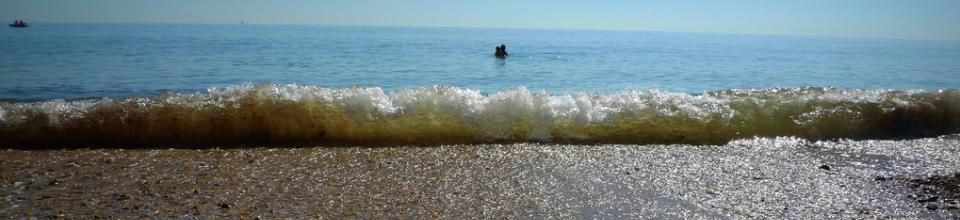
On Our Honeymoon I Write Your Secret Name In The Sand
It is true, I was pregnant when I married
your father and by the time of our honeymoon
I was front-heavy. So I packed Emily Dickinson
and Sylvia Plath's collected poems, maternity clothes,
bread and cheese. We rented a cabin with a jet tub
and no wi-fi on the reservation where the only restaurant
stays closed all winter.
This coast is your father's coast.
He owns its stars like the freckles on his neck.
I can only visit. Like Cassiopeia,
you are suspended between,
but held under my skin, for now.
He has been learning these beaches
since he was a boy wiping fingers, sticky
with tang and marshmallow, on his sweatpants,
collecting rocks. Still he camps here,
when it's too cold for tourists
memorizing the shape of every sea stack,
frying chanterelles, passing rum around the fire.
What I'm trying to tell you is this:
you were there that February weekend
with such little rain. We walked the beach
naming kelpies, limpets, cat paws,
seeing the pink of mineral stained caves,
the high, thin island where the Quileute once lashed
themselves with nettles and jumped into the sea.
I wrote your secret name in the sand, then,
not far from a tide pool where you may, one day,
feel the sting of anemone, lifted my shirt
below my breasts, posed for a picture.
Alder
I can't count the times
you've broken my heart.
The sound of your leaves,
skirts of a bride.
The woman packing her clothes
one last time. At 14, I wrapped
my arms around you in prayer,
before my parents logged the back 30
to pay for crack, hookers, my dad's new Olds.
My mother said they would keep you
to shade her rhododendrons
but the loggers did you in,
split your trunk more than even lightning could
An accident, they said,
an accident outside my kitchen window.
No one cares much for a woman
or an alder in the country.
For John Four Years Later (Or Why I'm Not Hanging Around The Finish Line Of Your
Girlfriends Marathon)
I am a woman. I have seen too many romantic comedies
where the heroine leaves everything behind to run
through the rain, throw her arms around an old flame
whom she never quite got over. But I have too much at stake
here, the wet pink roses outside the kitchen window,
the neighbor’s blue house, their week-old baby,
nearly half a bottle of Malbec left over from last night’s dinner.
Besides, it is your girlfriend running
in the rain, not me. I would not call you
“the one who got away”. No, it was my hair tangled
in the spider plant that time we went for drinks at Tiny Tavern,
my ex-boyfriend who kept me caged in his apartment.
I’m microwaving my coffee now. Two miles away
Amy runs to the finish line flushed and high
from the race and the man I love asks me
how writing is part of helping to clean
the kitchen. I’m going to tuck this poem away now,
bleach the counter. Later, I will scrub the black
and white floor tiles, try again to remove the stains
that will not budge, the blood of a woman who once lived
here, the time her lover swung his fist across her nose.