
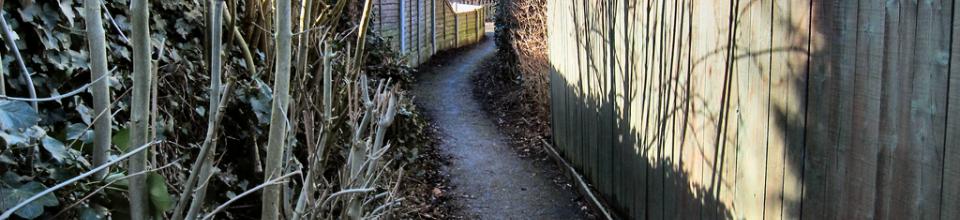
Alley poem #1
Across the alley 5 children under the age of 8 shout. 2 intermittently cry. I'm glad they're there. The water splashes, and a bam bam bam bam of something against the recently remodelled, stained fence, silence too: no parental voices, I can see the top of one adult head slouching against the back window. I think that's a bottle being raised to what must be the general area of the mouth. One particularly piercing scream, mommy save me in response to the flight path of a bee, and one robed adult comes running. Oh yes, I'm glad the children are over there.
Alley poem #2
Writing a poem in the back alley, I could have written the eagle lifting wind two streets away, but a cloud of starlings upending the chickadee's seed plate on my neighbour's 2nd story porch, yearling beak clatter, turmoil on wings and flying seeds, stamping shout, the neighbour's arms milling as he reached the still tottering plate, seed chaff and bird feathers spitting out into the alley's empty air―when I remembered to look back, the eagle had gone. So I didn't finish it.
Alley poem #3
On the other side, the neighbour washes rose petals off the pavement as soon as they fall. There seems to be some tension between us: she doesn't like it when my 3-year-old kale sprouts with attendant weeds too close to the fence line. Her strawberries-in-a-row growing next to volunteer dandelions and sowthistle generates a smile only for me. I wonder if it is the pink against the grey concrete of her back yard that has her spitting? Or last night's repositioning of the abundant pots of stinkweed and ragwort enlisted, as they were, for front-line duty?
2 rooms for the wake
one where the dead lies;
where long lines
curl silently;
offer solace
to the dead man's
last wife
&
one where the women
war over kettles of potato
& deermeat stew
Biological Indiscretions
This European sycamore got its name
because a 16th century Christian traveler
and botanist was smitten by the sycamore fig,
that sycamore which the thief climbed to see Jesus pass.
The difference between a middle-eastern fig, lit from within
by the glimmer of sweet orange fruits, clustering close
to the trunk like jack-o-lanterns,
and the European maple decked with small brown wings
was not a critical determinant. At best it was nominal.
Such a mistake seems some species of indifference,
some genera of biological indiscretion.
Misnomer compounded a hundred or so years later:
the name migrated to the land now known as
The Americas. The incapacity
to tell one colored fruit from another:
first a Ficus from an Acer,
then the brown maple whose small pendant globes,
made from the gathering of hundreds of tiny wings,
fly when broken open.